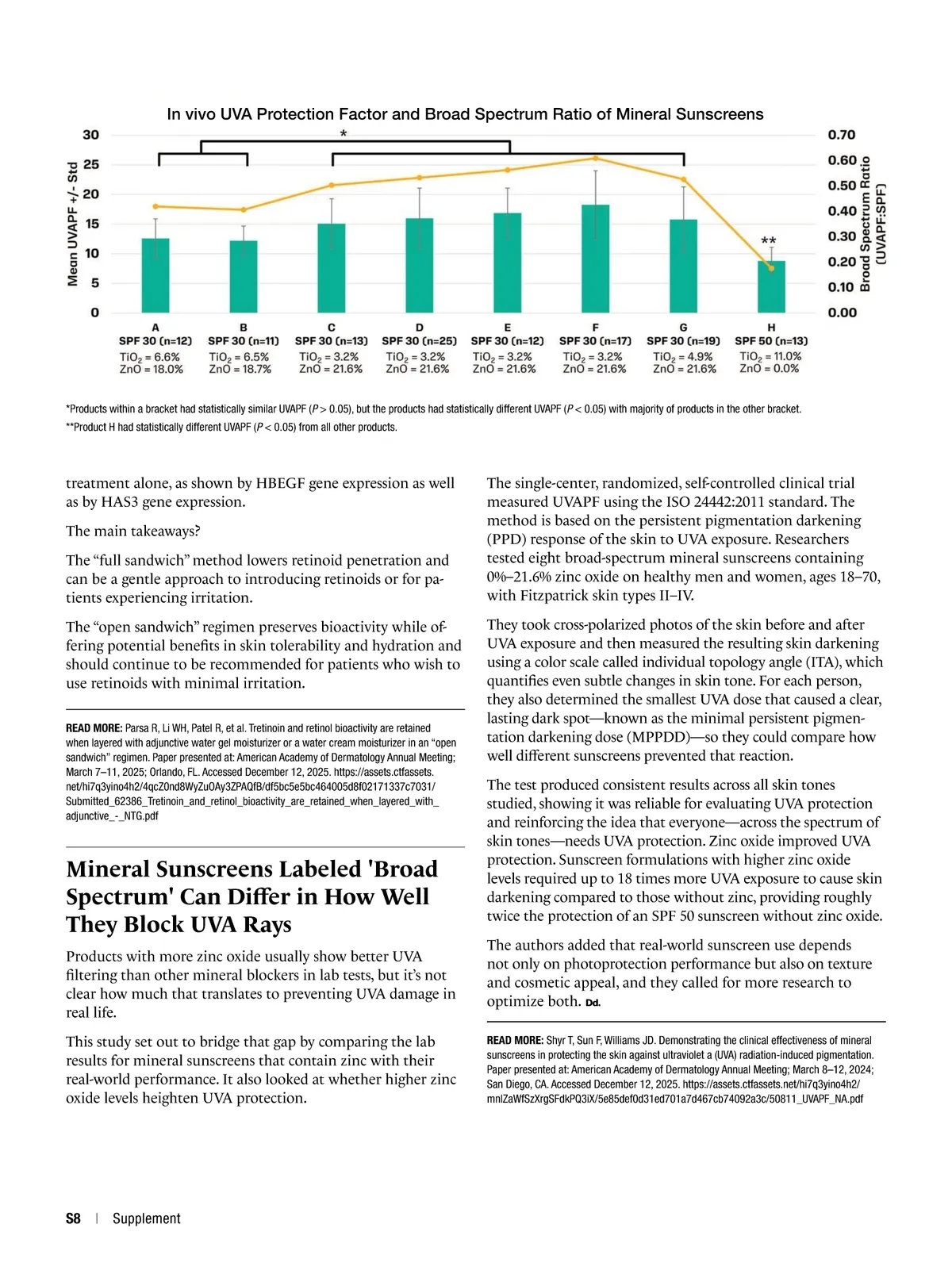
In vivo UVA Protection Factor and Broad Spectrum Ratio of Mineral Sunscreens *Products within a bracket had statistically similar UVAPF ( P > 0.05), but the products had statistically different UVAPF ( P < 0.05) with majority of products in the other bracket. **Product H had statistically different UVAPF ( P < 0.05) from all other products. treatment alone, as shown by HBEGF gene expression as well as by HAS3 gene expression. The main takeaways? The “full sandwich” method lowers retinoid penetration and can be a gentle approach to introducing retinoids or for pa-tients experiencing irritation. The “open sandwich” regimen preserves bioactivity while of-fering potential benefits in skin tolerability and hydration and should continue to be recommended for patients who wish to use retinoids with minimal irritation. READ MORE: Parsa R, Li WH, Patel R, et al. Tretinoin and retinol bioactivity are retained when layered with adjunctive water gel moisturizer or a water cream moisturizer in an “open sandwich” regimen. Paper presented at: American Academy of Dermatology Annual Meeting; March 7–11, 2025; Orlando, FL. Accessed December 12, 2025. https://assets.ctfassets. net/hi7q3yino4h2/4qcZ0nd8WyZuOAy3ZPAQfB/df5bc5e5bc464005d8f02171337c7031/ Submitted_62386_Tretinoin_and_retinol_bioactivity_are_retained_when_layered_with_ adjunctive_-_NTG.pdf The single-center, randomized, self-controlled clinical trial measured UVAPF using the ISO 24442:2011 standard. The method is based on the persistent pigmentation darkening (PPD) response of the skin to UVA exposure. Researchers tested eight broad-spectrum mineral sunscreens containing 0%–21.6% zinc oxide on healthy men and women, ages 18–70, with Fitzpatrick skin types II–IV. They took cross-polarized photos of the skin before and after UVA exposure and then measured the resulting skin darkening using a color scale called individual topology angle (ITA), which quantifies even subtle changes in skin tone. For each person, they also determined the smallest UVA dose that caused a clear, lasting dark spot—known as the minimal persistent pigmen-tation darkening dose (MPPDD)—so they could compare how well dierent sunscreens prevented that reaction. The test produced consistent results across all skin tones studied, showing it was reliable for evaluating UVA protection and reinforcing the idea that everyone—across the spectrum of skin tones—needs UVA protection. Zinc oxide improved UVA protection. Sunscreen formulations with higher zinc oxide levels required up to 18 times more UVA exposure to cause skin darkening compared to those without zinc, providing roughly twice the protection of an SPF 50 sunscreen without zinc oxide. The authors added that real-world sunscreen use depends not only on photoprotection performance but also on texture and cosmetic appeal, and they called for more research to optimize both. Dd . READ MORE: Shyr T, Sun F, Williams JD. Demonstrating the clinical effectiveness of mineral sunscreens in protecting the skin against ultraviolet a (UVA) radiation-induced pigmentation. Paper presented at: American Academy of Dermatology Annual Meeting; March 8–12, 2024; San Diego, CA. Accessed December 12, 2025. https://assets.ctfassets.net/hi7q3yino4h2/ mnlZaWfSzXrgSFdkPQ3iX/5e85def0d31ed701a7d467cb74092a3c/50811_UVAPF_NA.pdf Mineral Sunscreens Labeled 'Broad Spectrum' Can Dier in How Well They Block UVA Rays Products with more zinc oxide usually show better UVA filtering than other mineral blockers in lab tests, but it’s not clear how much that translates to preventing UVA damage in real life. This study set out to bridge that gap by comparing the lab results for mineral sunscreens that contain zinc with their real-world performance. It also looked at whether higher zinc oxide levels heighten UVA protection. S8 | Supplement
The Dermatology Digest Innovations in Pre-, Peri-, and Post- Procedure Skincare December 2025: S-8