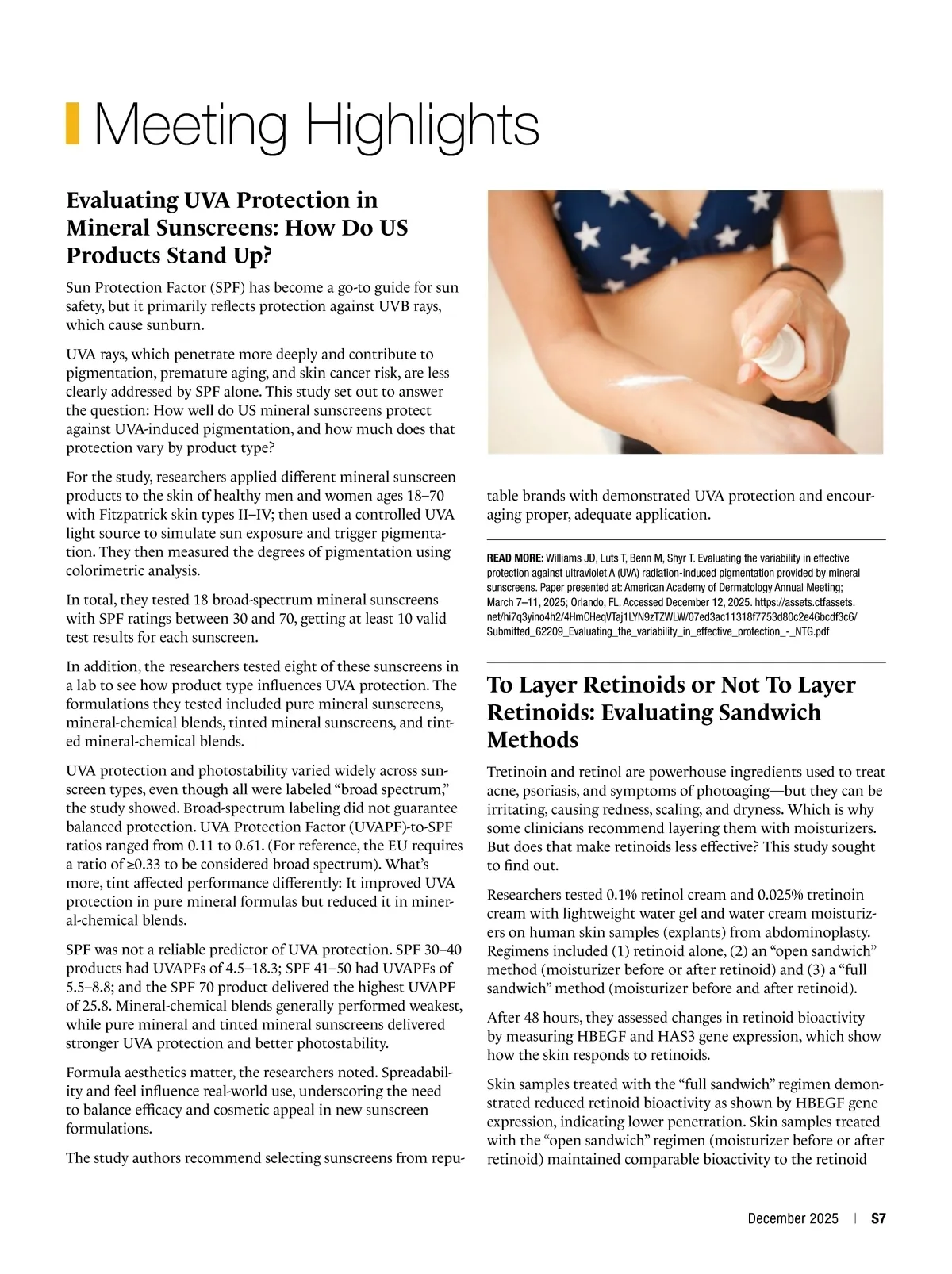
Meeting Highlights Evaluating UVA Protection in Mineral Sunscreens: How Do US Products Stand Up? Sun Protection Factor (SPF) has become a go-to guide for sun safety, but it primarily reflects protection against UVB rays, which cause sunburn. UVA rays, which penetrate more deeply and contribute to pigmentation, premature aging, and skin cancer risk, are less clearly addressed by SPF alone. This study set out to answer the question: How well do US mineral sunscreens protect against UVA-induced pigmentation, and how much does that protection vary by product type? For the study, researchers applied dierent mineral sunscreen products to the skin of healthy men and women ages 18–70 with Fitzpatrick skin types II–IV; then used a controlled UVA light source to simulate sun exposure and trigger pigmenta-tion. They then measured the degrees of pigmentation using colorimetric analysis. In total, they tested 18 broad-spectrum mineral sunscreens with SPF ratings between 30 and 70, getting at least 10 valid test results for each sunscreen. In addition, the researchers tested eight of these sunscreens in a lab to see how product type influences UVA protection. The formulations they tested included pure mineral sunscreens, mineral-chemical blends, tinted mineral sunscreens, and tint-ed mineral-chemical blends. UVA protection and photostability varied widely across sun-screen types, even though all were labeled “broad spectrum,” the study showed. Broad-spectrum labeling did not guarantee balanced protection. UVA Protection Factor (UVAPF)-to-SPF ratios ranged from 0.11 to 0.61. (For reference, the EU requires a ratio of ≥0.33 to be considered broad spectrum). What’s more, tint aected performance dierently: It improved UVA protection in pure mineral formulas but reduced it in miner-al-chemical blends. SPF was not a reliable predictor of UVA protection. SPF 30–40 products had UVAPFs of 4.5–18.3; SPF 41–50 had UVAPFs of 5.5–8.8; and the SPF 70 product delivered the highest UVAPF of 25.8. Mineral-chemical blends generally performed weakest, while pure mineral and tinted mineral sunscreens delivered stronger UVA protection and better photostability. Formula aesthetics matter, the researchers noted. Spreadabil-ity and feel influence real-world use, underscoring the need to balance ecacy and cosmetic appeal in new sunscreen formulations. The study authors recommend selecting sunscreens from repu-table brands with demonstrated UVA protection and encour-aging proper, adequate application. READ MORE: Williams JD, Luts T, Benn M, Shyr T. Evaluating the variability in effective protection against ultraviolet A (UVA) radiation-induced pigmentation provided by mineral sunscreens. Paper presented at: American Academy of Dermatology Annual Meeting; March 7–11, 2025; Orlando, FL. Accessed December 12, 2025. https://assets.ctfassets. net/hi7q3yino4h2/4HmCHeqVTaj1LYN9zTZWLW/07ed3ac11318f7753d80c2e46bcdf3c6/ Submitted_62209_Evaluating_the_variability_in_effective_protection_-_NTG.pdf To Layer Retinoids or Not To Layer Retinoids: Evaluating Sandwich Methods Tretinoin and retinol are powerhouse ingredients used to treat acne, psoriasis, and symptoms of photoaging—but they can be irritating, causing redness, scaling, and dryness. Which is why some clinicians recommend layering them with moisturizers. But does that make retinoids less eective? This study sought to find out. Researchers tested 0.1% retinol cream and 0.025% tretinoin cream with lightweight water gel and water cream moisturiz-ers on human skin samples (explants) from abdominoplasty. Regimens included (1) retinoid alone, (2) an “open sandwich” method (moisturizer before or after retinoid) and (3) a “full sandwich” method (moisturizer before and after retinoid). After 48 hours, they assessed changes in retinoid bioactivity by measuring HBEGF and HAS3 gene expression, which show how the skin responds to retinoids. Skin samples treated with the “full sandwich” regimen demon-strated reduced retinoid bioactivity as shown by HBEGF gene expression, indicating lower penetration. Skin samples treated with the “open sandwich” regimen (moisturizer before or after retinoid) maintained comparable bioactivity to the retinoid December 2025 | S7
The Dermatology Digest Innovations in Pre-, Peri-, and Post- Procedure Skincare December 2025: S-7