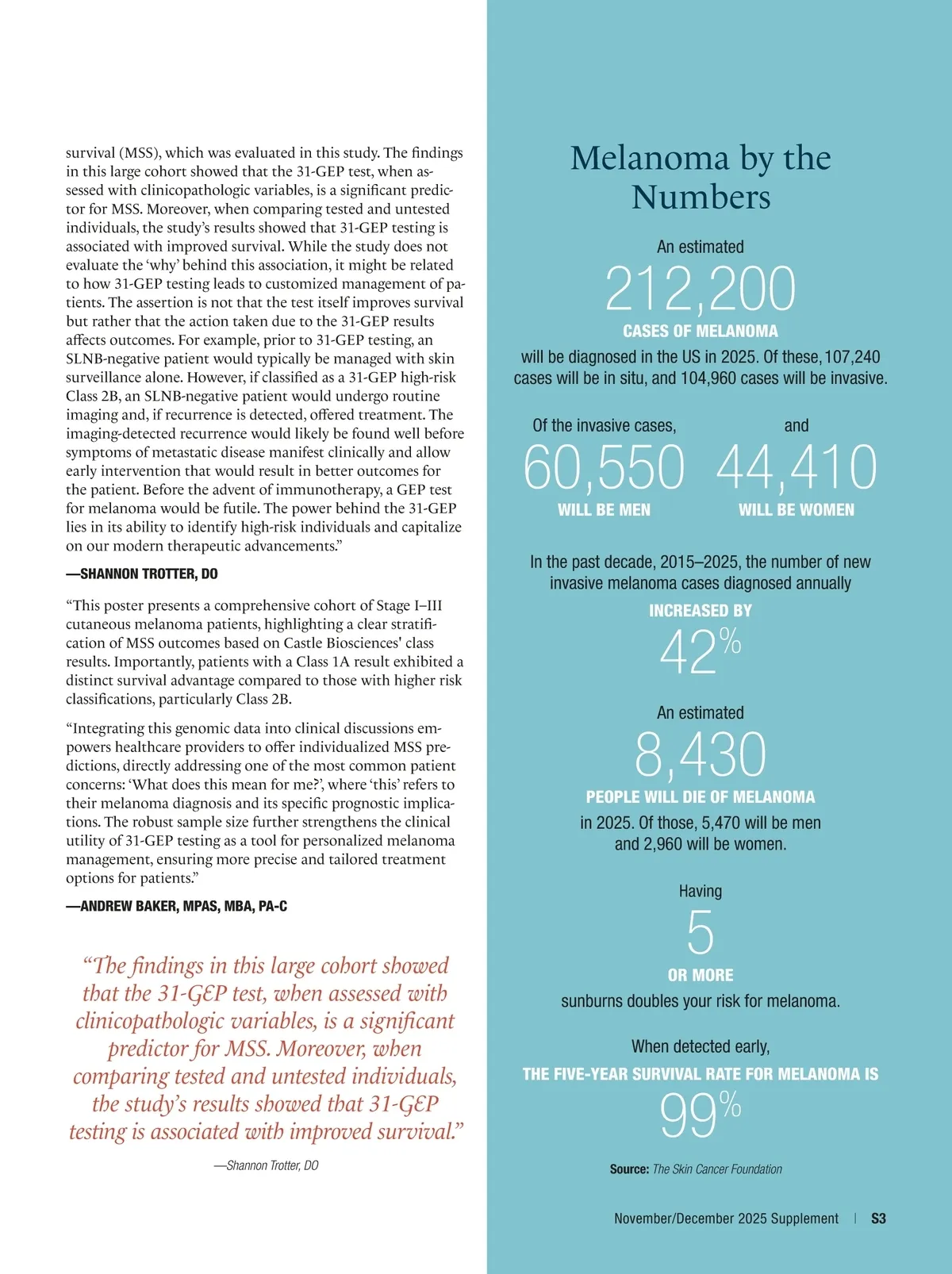
survival (MSS), which was evaluated in this study. The findings in this large cohort showed that the 31-GEP test, when as-sessed with clinicopathologic variables, is a significant predic-tor for MSS. Moreover, when comparing tested and untested individuals, the study’s results showed that 31-GEP testing is associated with improved survival. While the study does not evaluate the ‘why’ behind this association, it might be related to how 31-GEP testing leads to customized management of pa-tients. The assertion is not that the test itself improves survival but rather that the action taken due to the 31-GEP results affects outcomes. For example, prior to 31-GEP testing, an SLNB-negative patient would typically be managed with skin surveillance alone. However, if classified as a 31-GEP high-risk Class 2B, an SLNB-negative patient would undergo routine imaging and, if recurrence is detected, offered treatment. The imaging-detected recurrence would likely be found well before symptoms of metastatic disease manifest clinically and allow early intervention that would result in better outcomes for the patient. Before the advent of immunotherapy, a GEP test for melanoma would be futile. The power behind the 31-GEP lies in its ability to identify high-risk individuals and capitalize on our modern therapeutic advancements.” —SHANNON TROTTER, DO “This poster presents a comprehensive cohort of Stage I–III cutaneous melanoma patients, highlighting a clear stratifi-cation of MSS outcomes based on Castle Biosciences' class results. Importantly, patients with a Class 1A result exhibited a distinct survival advantage compared to those with higher risk classifications, particularly Class 2B. “Integrating this genomic data into clinical discussions em-powers healthcare providers to offer individualized MSS pre-dictions, directly addressing one of the most common patient concerns: ‘What does this mean for me?’, where ‘this’ refers to their melanoma diagnosis and its specific prognostic implica-tions. The robust sample size further strengthens the clinical utility of 31-GEP testing as a tool for personalized melanoma management, ensuring more precise and tailored treatment options for patients.” —ANDREW BAKER, MPAS, MBA, PA-C Melanoma by the Numbers 212,200 CASES OF MELANOMA An estimated will be diagnosed in the US in 2025. Of these, 107,240 cases will be in situ, and 104,960 cases will be invasive. 60,550 44,410 WILL BE MEN WILL BE WOMEN Of the invasive cases, and In the past decade, 2015–2025, the number of new invasive melanoma cases diagnosed annually INCREASED BY 42 % PEOPLE WILL DIE OF MELANOMA 8,430 Having An estimated in 2025. Of those, 5,470 will be men and 2,960 will be women. “The findings in this large cohort showed that the 31-GEP test, when assessed with clinicopathologic variables, is a significant predictor for MSS. Moreover, when comparing tested and untested individuals, the study’s results showed that 31-GEP testing is associated with improved survival.” —Shannon Trotter, DO OR MORE 5 sunburns doubles your risk for melanoma. When detected early, THE FIVE-YEAR SURVIVAL RATE FOR MELANOMA IS 99 % Source: The Skin Cancer Foundation November/December 2025 Supplement | S3
The Dermatology Digest November/December 2025 Castle Supplement: S-3